
There are design principles that should be taken into account when creating graphics. These principles are often what set good design apart from poor design. Each of these principles has a link with the other principles and can be observed in any well-designed piece of work you see. A firm understanding of design theory will guarantee that your work will always have logical substance in it.
Contrast, hierarchy, alignment, balance, proximity, repetition, simplicity, and function are the primary design principles. Whatever you create, whether it be for a magazine, poster, website, or advertisement, design principles should be taken into account. These rules and guidelines should be kept in the toolkit of every designer, and they should be used consciously as they develop their concepts.
Let’s explore the design principle repetition in more detail.
1. Three types of repetition in design
Digging deeper, there are three types of design principle repetition. Actually, design principle repetition is one of the three repetition techniques. The other two types of design principle repetition are pattern and rhythm.
Repetition
Design principle repetition, which is related to consistency, describes how the same elements appear repeatedly on a design. Repetition not only makes a design consistent but also provides aesthetic appeal. For example, using the same font type and color for all of your headings or including a repetitive background pattern in your design. It invites your audience to unintentionally connect some individual aspects. Just like when you stop at an intersection and the light turns green a short while later, you know it is safe to move forward. Our daily lives have become so accustomed to the green light being associated with driving that there might be some uncertainty without it.
In the field of graphic design, design principle repetition may be compared to this. The more consistent you are with particular design elements, the more repetition can be utilized to improve and clarify information. There should always be an intentional decision before you create a repetitive design.
A great example of design principle repetition is branding. Any successful brand will consistently adopt a graphic dialect or style. This can appear in a variety of ways, including the continuous use of a certain color scheme, a specific font or group of fonts, shapes and patterns, symbols, alignment styles, photography style, tone of voice, and so forth. All of these repetitive patterns in branding are not a coincidence. This is a carefully planned design strategy that aims to produce a recognizable and memorable look and feel. Any company that wants to succeed needs to have consistent yet distinctive and engaging branding. The same is true for brand presentations, posters, and brochures. Maintaining consistency and attention is beneficial and provides value.
Magazines provide another good example of design principle repetition. Any well-designed magazine will have a consistent style if you flip through it. This is done to produce a specific user experience that you will like and desire to have repeatedly. When you come to a design, observe how the design principle repetition has been taken into account. What elements—and in what ways—have been repeated? Is there a clear consistency? How well does it perform as an element of the design?

Patterns
A pattern is a technique for repeatedly using design elements that have the same size, form, or even color to create a unified composition. These patterns can go on forever because of their clear repetition and consistency. The polka dot pattern is a traditional illustration of a pattern. The same size and color of circles are used throughout the entire piece to create the polka dot pattern.
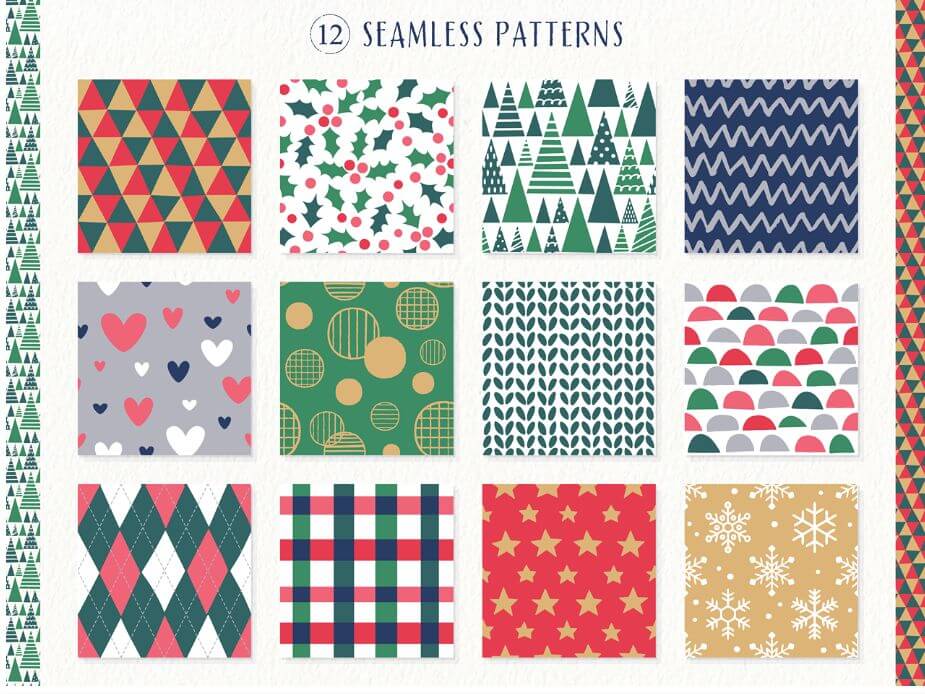
Another way to add patterns is to utilize a small palette of colors repeatedly. A color palette is what you see in google branding. Google has a distinctive color scheme that is present in all of its products and applications.
(Learn more about various types of patterns in graphic design.)

Rhythm
Rhythm in graphic design refers to the gap between different elements in a design and how these elements interact with one another. Rhythm usually manifests itself in one of five basic ways. You can use a variety of techniques to build a sense of rhythm and harmony in your graphic designs. Decide what effect you want to achieve with your piece. There is a significant difference between the emotion created by regular rhythm and the feeling inspired by progressive rhythm.
While regular rhythm frequently generates a fixed effect in the mind of the observer, progressive rhythm may create feelings of growth or change as the viewer engages with the design. Make sure that your rhythm is in harmony with the rest of your piece. Don’t forget to employ white space to bring focus to certain elements or to draw attention to your entire rhythm.

Design principle: 5 types of rhythm designers should know
Rhythm in graphic design follows the same rules as it does in any other art form. Graphic designers are in charge of creating logos, websites, advertising pieces, and much more. As a result, designers are required to express emotions and moods that meet specific objectives and specifications. Rhythm is one technique to accomplish this. The repetition of elements, as well as the gaps between them, provide a sense of harmony and consistency. Rhythm is created in music by notes and the silences between them; rhythm is created in art and design by the repetition of elements and patterns.
The white spaces between repetitions are as powerful as the repetitions themselves: they generate rhythmic intervals visually. Shorter intervals can express a sense of speed and vitality, whilst longer intervals might convey a calmness. Line, shape, color, and form are visual components used in graphic design and other art forms to create rhythm. Because the human eye is drawn to similarities between shapes, repeating shapes, lines, and forms are used. Color is also used by artists to generate repetition, giving their works a feeling of specific tone and ambiance.
There are five basic types of rhythm in graphic design. Each has a different impact on the viewer and creates a unique sense of visual harmony and rhythm.

Regular rhythm
When the intervals between elements, or the elements themselves, are identical in size or length, a regular rhythm develops. Regular rhythm repeats the elements at regular intervals. Typically, both the interval and the elements are consistent, though either might be modified. The repetition of a regular rhythm results in a less engaging although not necessarily dull rhythm.
The positioning of the same element regularly is typically in a straight line. Color, form, pattern, or another element characteristic can be repeated at regular intervals. To create interest, adjust the interval of the white space, which affects the rhythm’s tempo. You can also change the element’s characteristics. You can keep the size and shape constant while changing the color, or you can keep the color and shape consistent while changing the size. This variety adds complexity as well as excitement to the rhythm.

Flowing rhythm
A flowing rhythm is intended to generate a sense of movement. Designers may frequently repeat key aspects of the piece, not precisely, but in a structured flow across the piece, creating the feeling of movement and guiding viewers through the piece in a predetermined rhythm. In other words, a flowing rhythm occurs when the elements or intervals are organic. To generate a sense of movement, natural patterns are utilized. Typically, the element is distinct, yet similar, across each interval. The stripes of a tiger or zebra are fantastic examples. No two stripes are the same. When seen together, they form a natural moving rhythm.

Progressive rhythm
Progressive rhythm happens when a sequence of elements, lines, or shapes is displayed in a sequence of steps. The elements in such cases repeat over an interval, but with more diversity, frequently in progressive increments. The element’s size, shape, or color may change in steps throughout each interval, or the interval itself may change. The steps should be taken systematically.
The element’s properties should progressively increase or decrease, producing a sense of direction across the sequence. The variation adds interest and visual intensity while also directing the eye along the sequence. A color gradient is an example of a progressive rhythm. Another example of progressive rhythm is gradually reducing the size of an element as it fades into the background.
Alternating rhythm
When two different repeating elements alternate back and forth, this is referred to as an alternating rhythm. Alternating rhythm involves the incorporation of two or more interchangeable patterns or designs that are repeated throughout a piece. In alternating rhythm, the same pattern is sometimes used, but different colors are employed to produce an alternate rhythm. A good example is the squares on a chessboard, where repetitive white squares alternate with repeating black squares to make the game board.
Random rhythm
Random rhythm is the random use of elements in no particular order, sequence, or pattern. This produces a sense of chaos and urgency, as well as a high level of energy. This can be done with any element in an artwork. The creation of a sense of randomness results in feelings of disorganization. Random rhythms can be found at pebble beaches, snowfall, clover fields, cattle herds, and traffic jams. What appears random on one scale may reveal purpose and order on another. Progression happens when the size, number, color, or other attributes of the items repeated gradually increases or decreases.
Conclusion
Design principle repetition is a basic concept of graphic design that deals with the repeated usage of the same or similar design elements to create a coherent work. It is essential when creating unique and consistent graphic design styles as well as brand identities. It is now a fact that design principle repetition has three principles or methods: repetition, pattern, and rhythm. They provide graphic design consistency, pace, and movement. Using design principle repetition effectively in graphic design is very important. When incorporating design principle repetition and rhythm into your design, make conscious decisions about what you want people to associate with your brand.
You may need to repeat certain colors, elements, or images related to your brand in order to associate them with a specific product. For example, you may have a certain tagline or slogan that you want to be connected with your branding and content. The more frequently individuals come into contact with information, the more likely they are to remember it and associate it with you. You may help their minds remember that information by repeating it to them. The difference between a boring, static image and one that jumps off the page or screen can be achieved by repetition. Including design principle repetition in elements helps to create an emotional response or to make your work feel more realistic.